Family owned in North Pinellas County since 1990 Seven days a week, 9:00 AM to 5:00 PM
Jack Coniam, Inc. Lawn & Landscaping
Service

Property cleanups

A cleanup is one visit that takes a property which has got away from anybody and puts it back to a state a regular schedule can hold. It is a different job from a maintenance visit, and on an overgrown yard it is the job that has to happen first.

What it is
One visit, sized to the property rather than to a route
Usual reasons
Overgrowth, a vacant rental, a storm, or a sale coming up
The work
Grass down in stages, beds cleared, shrubs cut back, debris gathered
Usual next step
A weekly or every other week schedule to hold it there
01 When a cleanup is the right call

Four situations a cleanup covers

A cleanup is usually asked for in one of four situations. The work is much the same in each of them: the property comes back to a baseline, and then you decide what keeps it there.

The yard has got ahead of the owner

A mower breaks, a job gets busy, or a summer of afternoon storms does what it does. Grass at eight or ten inches, beds full of weeds and shrubs growing over the walkway is a normal starting point and not something to apologize for on the phone.

A vacant or between tenant rental

A property with nobody living in it keeps growing anyway. Owners and property managers usually want it brought back before a showing or before a new tenant moves in, and then held on a schedule for as long as it is occupied.

After a storm

A summer storm or a tropical system leaves fronds, small limbs and yard debris spread across a property. Clearing that is a cleanup rather than a mowing visit, and the lawn under it usually needs cutting once the debris is off it.

Before a sale or an inspection

The yard is the first thing a buyer or an inspector sees. Ahead of photographs, a showing or an inspection, cut grass, sharp edges, cleared beds and fresh mulch make a visible difference to a property in a single visit.

02 The visit

What a cleanup does that a regular visit does not

A maintenance visit holds a property where it already is. A cleanup has to move it, and that is different work over a much longer visit.

  • Overgrown grass comes down in stages. Taking a lawn from ten inches to four in one pass scalps the turf, leaves a mat of clippings thick enough to smother whatever survived, and puts the grass under real stress in the heat. We take the top off, clear the clippings, then lower the height again.
  • Beds are cleared back to their lines. Weeds and lawn runners that have grown into a bed come out, the edge is cut back in, and the bed line goes back where the yard was laid out to have it.
  • Shrubs that have closed over paths and windows are cut back. Growth across a walkway, over a driveway, against the wall of the house or across a window is taken back, so the path is walkable again and light reaches the glass.
  • String trimming reaches what has been left the longest. Fence lines, tree rings, post bases, mailboxes and the strip behind the A/C unit are usually the parts of a neglected yard furthest gone.
  • The debris is gathered as the work goes. A cleanup produces far more material than a mowing visit, and none of it is left in the beds, on the lawn or out in the street.
  • Hard surfaces are blown clean at the end. Driveway, walkways, entry and the curb line, so the finish is actually visible when we leave.
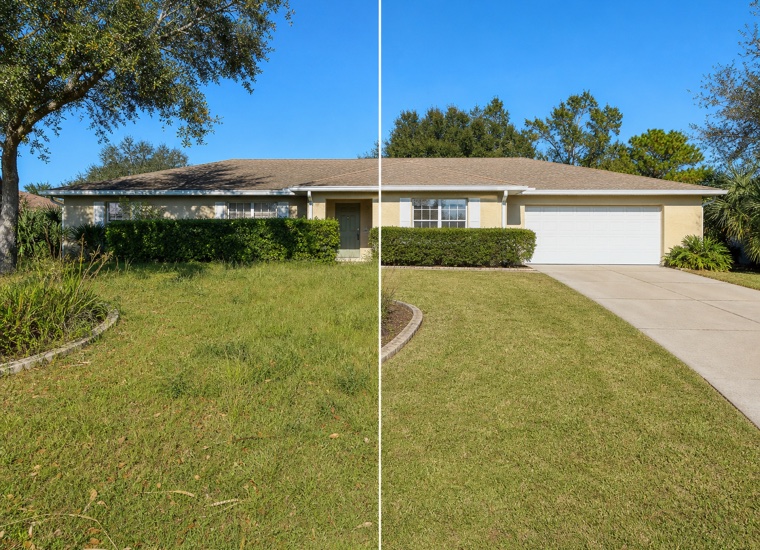
The same Florida front yard before and after a full property cleanup, shown side by side.
A before and after of the same front yard, side by side: overgrown on the left, and cut, edged and cleared on the right.
03 Why it is separate

Why a cleanup is booked separately from a schedule

People often expect the first visit on a new schedule to sort out an overgrown yard. It cannot, and it is more honest to explain why than to turn up and do half a job.

A maintenance visit is a slot on a route. It is sized for a lawn already at height, beds already at their lines and shrubs already in shape, and the work is to hold all three exactly where they are. A property that has been left for two months in July is not that job, and no amount of hurrying makes it that job.

A cleanup takes longer, uses equipment a mowing visit does not carry, and produces a volume of material that has to be dealt with. It also cannot always be finished in one pass, because a lawn that has to come down in stages needs a second cut a week or two later before it is back at a height a schedule can hold.

So the honest sequence is a cleanup first and a schedule after it. Putting an overgrown property straight onto a weekly route means the first several visits are spent catching up, the finish is never what anybody wanted, and the lawn takes the damage in the meantime.
  1. The cleanup visit

    The property comes back to a baseline. Grass down to a proper height, beds cleared to their lines, shrubs off the paths and windows, and the debris gathered up.

  2. A follow up cut where the grass came down in stages

    If the lawn was tall enough that it had to be lowered over more than one cut, it needs another visit a week or two later to reach the height it should be held at.

  3. A regular schedule from there

    Weekly through the growing season, every other week once growth slows. This is the part that keeps the property where the cleanup put it.

04 The debris

What happens to the material we cut

A cleanup produces a lot of material, and where that material ends up matters both to your property and to the storm drain at the end of the street.

We are trained and certified in Landscape Best Management Practices, and the part of that which shows up on a cleanup is straightforward. Yard debris is not left in the street, swept into the gutter or pushed toward a storm drain. In this county a storm drain runs to a creek, a bayou or the Gulf, and clippings and leaves carry nutrients that do not belong in any of them.

Material is gathered off the lawn and out of the beds as the work goes rather than left in piles to deal with at the end, and the hard surfaces are blown clean before we leave.

What a city or a county will take at the curb, and how it has to be presented for collection, is not the same in every community we cover. It is worth asking about for your own address when you call.

Questions worth asking on the call

  • What happens to the debris from your property.
  • Whether storm debris is handled, and what size of limb is beyond a cleanup visit.
  • Whether the lawn will need a second cut, and when.
  • What the property should go onto afterwards, if anything.
05 After the cleanup

What the property needs after the cleanup

A cleanup resets a property. What it does not do is stop the grass growing again, and in this climate that starts happening the same week.

Between April and October a lawn here puts on hard growth, and a property that took a cleanup to recover is a property that got that way in a few weeks of it. A regular schedule is what stops the same thing happening again, and it is a much smaller job each visit than the cleanup was.

The other work that pairs with a cleanup is the work that makes the reset look deliberate: hedges and foundation plantings shaped properly rather than just shortened, and fresh material in the beds at the right depth. Those two together are what separates a cut yard from a kept one.

Frequency after a cleanup

Time of yearUsual frequency
April to OctoberWeekly, while heat and afternoon storms push growth
November to MarchEvery other week, once growth slows right down
Any timeA one time visit, if a schedule is not what you want

Frequencies describe normal practice for this region. We will tell you what your property actually needs when we see it.

06 Related work

Other services that go with a cleanup

These three are the jobs most often booked around a cleanup, either on the same visit or as the schedule that follows it.

Free quotes

Tell us how far the yard has gone

Call us and we will come out and look at it. Nobody here is going to be shocked by an overgrown property, and you will get a plain answer on what it takes to bring it back. There is no obligation once you have it.

Seven days a week, 9:00 AM to 5:00 PM. Email cjackc.inc@gmail.com.

Call now Free quote