Family owned in North Pinellas County since 1990 Seven days a week, 9:00 AM to 5:00 PM
Jack Coniam, Inc. Lawn & Landscaping
Service

Hedge and bush trimming

Hedges, foundation plantings and ornamental shrubs need more than shortening. We shape them to the plant, thin them where they have closed up, and take the growth back off the walls, the windows and the roof line.

Booked as
On its own, or added to a scheduled maintenance visit
Plants covered
Hedges, foundation plantings and ornamental shrubs
Cuttings
Collected and taken away, not left in the beds
When to cut
It depends on whether the shrub flowers on old wood or new wood
01 Two different jobs

The difference between shearing a shrub and pruning it

Shearing is running a trimmer over the outside of a plant and taking every shoot back to the same flat plane. One shearing does a shrub no harm. A shrub that is cut that way every time slowly hollows out on the inside.

Every time a shrub is sheared it answers by putting a flush of new shoots out at the cut. Those shoots are all on the outside of the plant, so the outer few inches get denser and denser. That shell then shades everything behind it. After a few seasons of it you have a green skin about two inches thick over an interior of bare twigs, and the plant has no live growth left down inside it.

The problem shows up the first time the shell is broken. A branch pulled out by a storm, scraped by a car door or cut back hard leaves a hole with nothing behind it to fill in, because there is no foliage in there to grow from. A hedge in that condition takes a long time to recover and sometimes does not.

Humidity is the other half of it. A shrub sheared into a solid box holds still, damp air inside it right through the wet season, and a plant with no air moving through it stays wet long after the rain has stopped. That is the condition fungal leaf spots and mildews need to get going.

Pruning is the alternative and it does not take longer. Cuts are made at different depths instead of all at one plane, so the outline of the hedge stays where you want it while light and air still reach the middle of the plant.
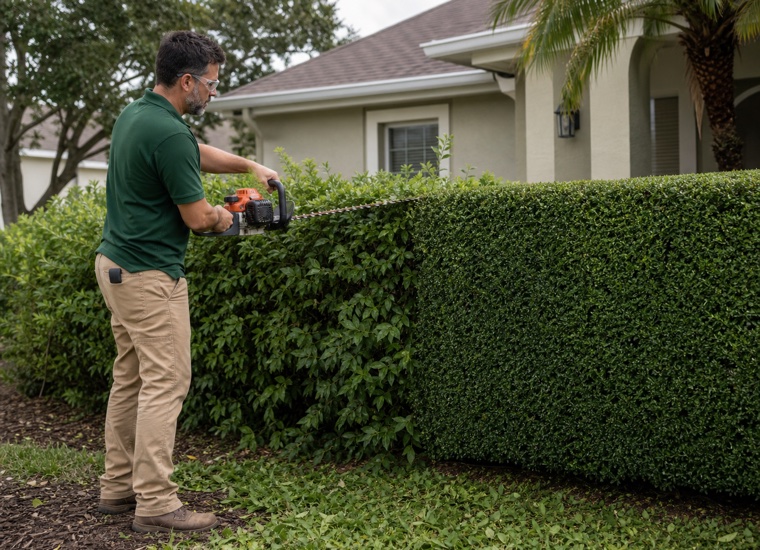
A crew member shaping a viburnum hedge with a hedge trimmer, half of it cut and half still shaggy.
02 The visit

What a hedge and bush trimming visit includes

Hedge work can be booked on its own or added to a maintenance visit. Either way the same four things happen, and the property is left clean.

  • The shape follows the plant. A shrub that wants to be round is kept round. A formal hedge is kept formal, but it is kept slightly narrower at the top than at the bottom so the lower growth still gets light and does not thin out and go leggy.
  • Growth is thinned where the shrub has closed up. We take some stems out deeper in the plant rather than tipping everything at the surface. That opens the shrub up, lets air through it and gives the interior enough light to hold its leaf.
  • Growth comes back off the house. Off the walls, out of the windows, down off the roof line and gutters, and clear of the meters, the hose bibs, the A/C unit and the walkway to the door.
  • The cuttings are collected and taken away. They do not get left in the beds to sit against the stems, and they do not get blown into the street or down a storm drain.

Booked on its own or on a schedule

Some properties only ever need the hedges done. Others have us do them as part of the regular visit so they never get away.

If you are not sure which suits your yard, we will look at the plants you have and say what we would do.

03 When to cut

The right time to cut depends on the plant

A flowering shrub carries next season's flowers on wood it has already grown, or on wood it has not grown yet, and the two are cut at opposite ends of the year. Cutting a spring flowering shrub in winter takes next season's flowers off with the clippings.

Shrubs that flower on old wood

Azalea, gardenia and Indian hawthorn set their flower buds on the growth they made the season before. The time to cut them is soon after they finish flowering, while there is still a long season left for them to make the wood that carries the next set of buds.

Shrubs that flower on new wood

Hibiscus, plumbago, oleander and ixora flower on growth they put out in the same season, so late winter or early spring is a safe time to cut them back. Ixora is the one that suffers most from being sheared, because a shearing takes the forming flower heads with it every time.

Hedges grown for their leaf

Viburnum, podocarpus and ligustrum are planted for foliage and screening rather than for flower, so they can be shaped through most of the year. The time to be careful is late fall, because a hard cut then pushes soft new growth out just as the first cold fronts come through.

04 Clearance off the house

Where the growth needs to be cut back to

Foundation plantings are the ones that cause trouble, because they are the closest to the building and they are usually the last thing anyone looks at.

Off the walls

Foliage held against a wall keeps it damp and keeps the paint from drying out after rain. A hand's width of air behind the shrub is enough to stop that.

Out of the windows

A shrub grown up over a window takes the light out of the room behind it and gives anyone outside something to stand behind. Windows are worth keeping clear for both reasons.

Off the roof line

Anything reaching the eaves, the soffit or the gutter drops leaf litter into the gutter and holds moisture against the fascia. It comes down off the roof line.

Clear of the walkway and the equipment

The path to the front door stays walkable, and the A/C unit, the meters and the hose bibs stay reachable for the people who need to get at them.

05 Related work

What usually gets booked with hedge work

Hedge work is often the point at which the rest of the beds get attention as well, because the shrubs and the ground under them are one job to look at.

Free quotes

Have us look at the hedges

Call us and we will come out, look at the plants you actually have and tell you what we would take off them and when. There is no obligation once you have it.

Seven days a week, 9:00 AM to 5:00 PM. Email cjackc.inc@gmail.com.

Call now Free quote